Showing posts with label pratchett. Show all posts

Wednesday, August 22, 2007

Night Watch

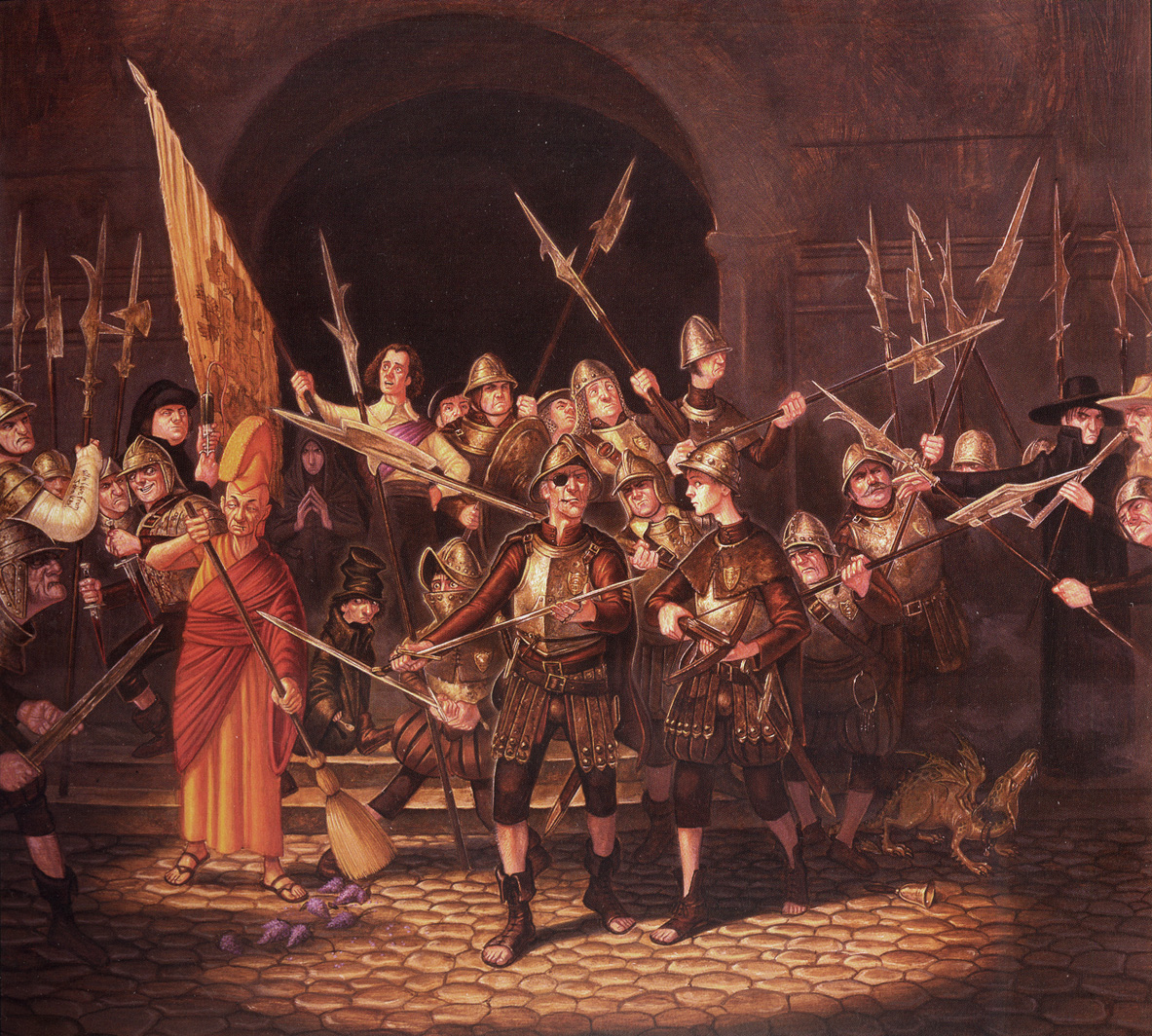
Paul Kidby is the official Discworld books illustrator. His first cover art was that of "Night Watch", the superb dark story of a revolution-coup in the familiar revolutions-coups tradition of the past century. Alas, this was the first book not to be illustrated by Master Josh Kirby, as he had passed away the previous year. The inspiration was Rembrandt's Night Watch painting. I'll post the two works, hoping that somehow I convinced even a little bit trying this book which I consider worth a read. To make a small confession: it was the only Discworld book that made me cry, with bitter tears, as I too have had the same feelings in some distant moment in one corner of the Multiverse.


Click to enlarge


Click to enlarge

Sunday, October 29, 2006

Pratchettphernalia

Been Discworlding again. Here are some quotes:
"The Patrician was not a man you shook a finger at unless you wanted to end up being able to count only to nine."
"Sergeant Colon owed thirty years of happy marriage to the fact that Mrs. Colon worked all day and Sergeant Colon worked all night. They communicated by means of notes. He got her tea ready before he left at night, she left his breakfast nice and hot in the oven in the mornings. They had three grown-up children, all born, Vimes had assumed, as a result of extremely persuasive handwriting."
"The trouble with being a god is that you've got no one to pray to."
"Gods don't like people not doing much work. People who aren't busy all the time might start to think."
"You couldn't put off the inevitable. Because sooner or later, you reached the place where the inevitable just went and waited."
"People think that professional soldiers think a lot about fighting, but serious professional soldiers think a lot more about food and a warm place to sleep, because these are two things that are generally hard to get, whereas fighting tends to turn up all the time."
"The Ephebians believed that every man should have the vote. [Footnote: Provided that he wasn't poor, foreign, nor disqualified by reason of being mad, frivolous, or a woman.]"
"Dhblah sidled closer. This was not hard. Dhblah sidled everywhere. Crabs thought he walked sideways."
"Bishops move diagonally. That's why they often turn up where the kings don't expect them to be."
"There were one thousand, two hundred and eighty-three religious books in [the library] now, each one -- according to itself -- the only book any man need ever read."

"...Vimes's grin was as funny as the one that moves very fast towards drowning men. And has a fin on top."

"A key to the understanding of all religion is that a god's idea of amusement is Snakes and Ladders with greased rungs. "

"Dwarfs are very attached to gold. Any highwayman demanding 'Your money or your life' had better bring a folding chair and packed lunch and a book to read while the debate goes on."

"There is a curse. They say: may you live in interesting times."

"Getting an education was a bit like a communicable sexual disease. It made you unsuitable for a lot of jobs and then you had the urge to pass it on."

"Don't put your trust in revolutions. They always come around again. That's why they're called revolutions. People die, and nothing changes."

"Vimes had never got on with any game much more complex than darts. Chess in particular had always annoyed him. It was the dumb way the pawns went off and slaughtered their fellow pawns while the kings lounged about doing nothing that always got to him; if only the pawns united, maybe talked the rooks round, the whole board could've been a republic in a dozen moves."

"...even ordinary books are dangerous, and not only the ones like Make Gelignite the Professional Way. A man sits in some museum somewhere and writes a harmless book about political economy and suddenly thousands of people who haven't even read it are dying because the ones who did haven't got the joke."

Sunday, October 01, 2006

The God of Small Gods

I we are to analyze this whole idea, we reach several conclusions.
First would be that, as Pratchett said, it's not Gods those who created humans, but humans are definitely those who created their Gods. The reason he gives is that basic trait of human nature of constant need of a higher supernatural existence to stick in ones blames. Or, as the old legend goes, it's Pandora's Box, i.e. the fact that Hope dies last.
Second, an odd theory springs to mind, a theory which separates the Creator from God and identifies them as two different beings. My first and only glimpse of a clue in this point is the Biblical paradigm shift (yes, another one... Maybe I should rename this blog to Paradigm Shifts), or the inexplicable re-baptism of God from Elohim- who actually are a pantheon of seven Gods- to Iehwe or Jehovah. In the Bible, Elohim is definitely appointed as the Creator of all there is, while Iehwe, beside some minor miracles, appears with remarkably inferior powers. Creator and God?
Third and last, is a strange book, maybe the strangest I read, who's only and true conclusion is that God can, and usually does, hides in the smallest insignificant things, there for those who have eyes to observe.
To make things short, God is in the details...

Thursday, September 28, 2006

Small Gods

It is the symbolic name of the best Discowrld novel, in my opinion. Or maybe the name is symbolic because we, humans, crave to find symbolism in every shred of written word. Because this symbolism is the very Small God we praise.
Terry Pratchett is, above everything else, a keen observer. He's not a talented writer, or cynic journalist, or moralist. Observer. Of human nature, of human thoughts, of human behavior, of all that is human. And he details the results of his prolonged observation in the simples logic way for those who want to observe. That, of course, if you're not too busy laughing your soul out at his solid baseless metaphors.
Small Gods is different, not because of it's sensitive subject. It's different because Pratchett projected himself in this book. I don't want to idealize the man, but then again, his projection is far from being idealistic. He projected himself and spoke his mind, instead as merely suggesting, as he did in all the other novel. He spoke his feeling, pointed the finger, cried of despair, demolished so he can rebuild, destroyed so he can recreate, and... resumed his silent observation. The ever same result he gets, we get, I get, when trying to change a speck of dust.